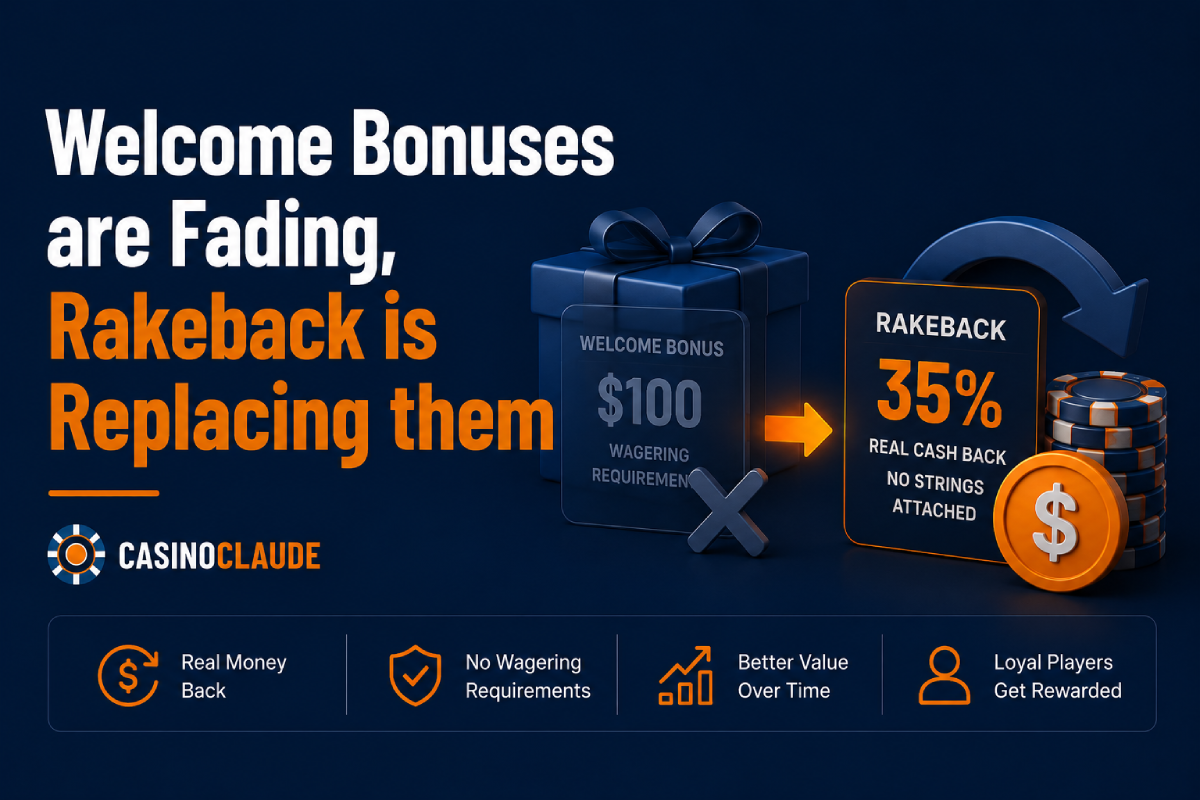
Compare a 2026 casino landing page with one from three years ago and the loudest change is the number at the top. The 200% mega-packages with free-spin avalanches are thinning out, and in their place sits something that sounds almost boring: 10% rakeback, weekly cashback, loyalty rates that tick up with play. The welcome bonus is not dead, but it has stopped being the main event, and the shift is bigger than a marketing fashion.
We track offer terms across eight markets, and the direction is consistent everywhere: smaller headline numbers, shorter wagering chains, and a growing share of value paid out as a percentage of what you actually play. This piece explains why the economics flipped, how to compare the two models with actual arithmetic, and where the new small print hides.
The incredible shrinking welcome offer
Three forces squeezed the classic welcome package at once. Regulators in the UK, Netherlands and Nordics pushed hard against offers that front-load value and lock it behind long wagering chains, with several markets now capping bonus size or banning wagering requirements above a set multiple outright. Bonus-abuse rings industrialised the other side, farming sign-up offers at scale until the expected cost of a big headline number stopped making sense. And operators finally accepted what their own data said: players acquired with a giant bonus churn out the moment it is spent. A smaller offer that keeps paying is cheaper and stickier.
Why rakeback won the economics
Rakeback, and its softer sibling cashback, pays you back a fixed percentage of your wagering or your net losses, usually weekly and usually in withdrawable cash. From the operator’s side it is beautifully self-regulating: the cost scales exactly with revenue, there is no cliff where a bonus hunter extracts value and leaves, and there is nothing to abuse because you only get paid in proportion to what you put through. Regulators quietly prefer it too. A cashback rate is one honest number, while a “100% up to €500” banner hides a wagering requirement, game weighting, a max bet rule and an expiry clock. Several licensing regimes now treat no-strings cashback as the model complaint-proof promotion.
The maths: 10% rakeback vs a 100% bonus
Here is the comparison most players never do. Take a classic 100% bonus up to €200 with 35x wagering on the bonus. To turn that €200 into withdrawable cash you must wager €7,000. On slots returning around 96%, the expected cost of €7,000 in spins is roughly €280. In other words, the average player pays €280 in expected losses to unlock €200, and the bonus expires worthless for everyone who does not finish the chain.
Now run the same €7,000 of wagering with no bonus but 10% rakeback on net losses. Your expected loss is the same €280, and the rakeback returns €28 in cash, no wagering, no expiry, no game weighting. The bonus looks seven times bigger on paper, but only if you complete the chain, and completion rates on 35x wagering are poor. The honest summary: a big welcome bonus is a lottery ticket with negative expected value for most people; rakeback is a small, guaranteed discount on the house edge. Which one suits you depends entirely on how much and how often you play.
Which model pays which player
The break-even point moves with volume. Roughly, this is how the models compare for three player profiles over a year.
| Offer type | Casual (€50/month) | Regular (€300/month) | Heavy (€1,500/month) |
|---|---|---|---|
| 100% welcome bonus, 35x wagering | Rarely cleared, near zero value | Sometimes cleared, value front-loaded to month one | Cleared quickly, then nothing |
| 10% rakeback on losses, weekly cash | A few euros back, modest but real | Steady value every month, beats the bonus by year end | Clearly the better deal, compounds all year |
| Hybrid: small bonus plus 5% cashback | Best of both for a first month | Competitive, watch the bonus terms | Weaker than pure rakeback at volume |
The traps to read for
Rakeback’s honesty made it a marketing word, and the word is now attached to schemes that do not deserve it. The most common trap is a minimum-wager gate: cashback only activates once you have put through a set turnover in the week, which turns a discount into a target that pushes you to play more. The second is game weighting sneaking back in, with live casino or table play accruing at a fraction of the slot rate. Watch also for rakeback paid as bonus funds with their own wagering attached, which is just the old model wearing a new badge, and for tiered VIP ladders where the advertised top rate requires volumes no recreational player should chase. If the cashback is cash, uncapped by a gate and arrives weekly, it is the real thing.
How this fits our reviews
Everything here reflects the way CasinoClaude tests casinos: real deposits, timed cash-outs and terms read to the last line. If you want to see the method applied to specific sites, pick a country from the top menu.
FAQ
Is rakeback always better than a welcome bonus?
No. For a one-off casual deposit, a fair welcome bonus with low wagering can still be worth more than months of small cashback. Rakeback wins once you play regularly, because its value scales with volume and never expires.
What is the difference between rakeback and cashback?
Rakeback is a percentage of your wagering or the house edge on it, paid regardless of results. Cashback is a percentage of your net losses, so a winning week pays nothing. Casinos use the words loosely, so always check which base the percentage applies to.
Why would a regulator prefer rakeback?
Because it is one transparent number with no wagering chain, no expiry pressure and no incentive to chase a target before a bonus dies. Most player complaints about bonuses involve wagering terms, and rakeback simply has none if it is paid in cash.
What is a good rakeback rate in 2026?
Genuine no-strings cashback typically sits between 5% and 15% of net losses, with crypto-facing sites at the top of that range. Anything advertised above 20% almost always hides a gate, a wagering requirement or a losses definition worth reading twice.